
The Challenge: The "Single-Machine" Bottleneck
(For non technical version see here)
The client, a busy formal wear rental organization, was operating on a fragile technical foundation. Their entire operation relied on an off-the-shelf legacy application installed on a single local Windows machine.
While the software functioned for basic tasks, the infrastructure created severe operational friction:
Access Limitations: Staff could not access data simultaneously. Remote access required logging into the physical machine via Remote Desktop (RDP), locking out local users.
Data Silos: Inventory status, customer history, and financial data were trapped on one hard drive, making real-time collaboration impossible.
Lack of Automation: Critical workflows—like flagging overdue items or calculating cleaning fees—relied on manual data entry, leading to human error.
The goal was to migrate from this brittle desktop environment to a scalable, cloud-native web application without sacrificing the speed and data density the staff was used to.
The Solution: A Laravel & Filament Architecture
We engineered a custom Formal Wear Rental Management System using a modern PHP stack designed for rapid development, type safety, and reliability.
The Tech Stack
Backend Framework: Laravel 11 We chose Laravel for its robust ecosystem and enterprise-grade features. It handles the heavy lifting of authentication, queue management, and database interactions, allowing us to focus on business logic.
Admin Interface: Filament PHP To replace the dense data-entry screens of the legacy desktop app, we used Filament. It provided a responsive, high-performance admin panel with advanced table views, filtering, and form builders out of the box. This allowed us to replicate the "power user" feel of desktop software within a web browser.
Database: MySQL / MariaDB A normalized relational database was essential for handling the complex web of relationships between Customers, Rentals, Gowns, and Payments.
Media Management: Spatie Media Library We implemented Spatie to handle image optimization and storage, allowing staff to upload cover and side-view photos for every gown in the catalog.
Technical Implementation Highlights
1. Automating State Management with Model Observers
In the old system, an item returned by a customer often stayed marked as "Rented" until someone manually updated it. We solved this using Laravel Model Observers.
We built an event-driven architecture where specific actions trigger automatic status updates:
Trigger: Staff marks a rental as "Returned."
Observer Action: The system automatically switches the Gown status to Cleaning and the Rental status to Closed (if all items are returned).
Result: Inventory availability is updated instantly without manual intervention, preventing double-booking.
2. Type-Safe Business Logic with Enums
To prevent data inconsistency—a major issue in the legacy database—we leveraged PHP Enums.
We defined strict Enums for statuses (e.g., RentalStatus::Reserved, GownStatus::Cleaning).
This ensures that the system never writes invalid states to the database, enforcing data integrity at the code level.
3. Asynchronous Processing with Queue Jobs
The system performs heavy calculations, such as generating financial reports or syncing large batches of inventory status updates.
Instead of making the user wait for these processes to finish, we offloaded them to Queue Workers.
This ensures the user interface remains snappy and responsive, even during peak operational hours.
4. Granular Permissions & Security
Moving to the cloud required a security overhaul. We implemented Role-Based Access Control (RBAC) via Laravel's Authorization Policies.
Unlike the "all-or-nothing" access of the Windows machine, the new system differentiates between Administrators (who can configure global settings like charity percentages) and Standard Staff (who focus on bookings and returns).
The Result
The migration successfully decoupled the business from its physical hardware.
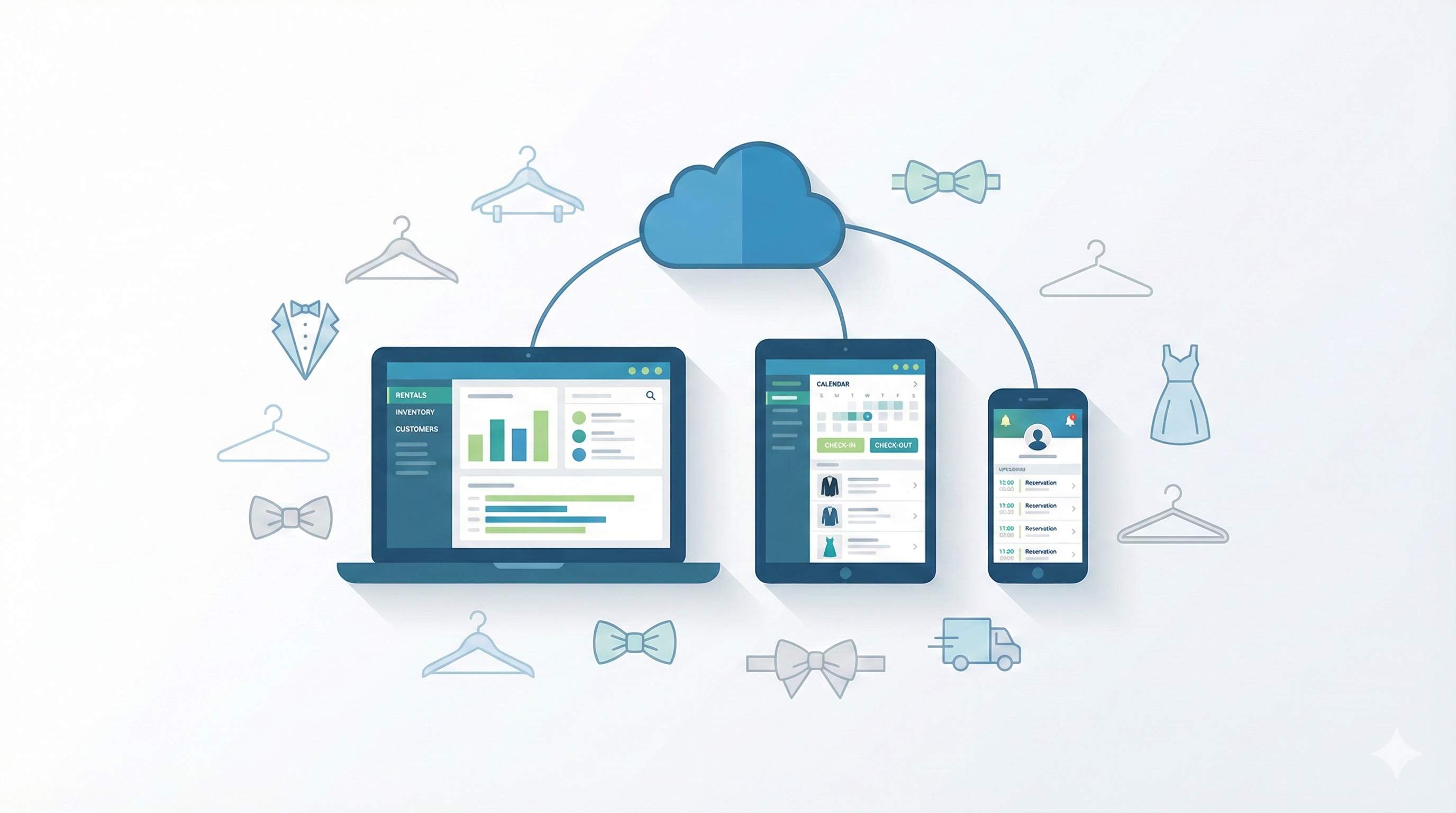
Accessibility: Staff can now manage rentals from iPads, laptops, or phones simultaneously, eliminating the RDP bottleneck.
Data Integrity: Automated workflows and strict typing have virtually eliminated inventory discrepancies.
Scalability: The architecture is built to grow. The foundation supports future enhancements like SMS notifications, barcode scanning, and a customer-facing portal without requiring a rewrite.
By leveraging Filament and Laravel, we delivered a solution that combines the accessibility of the web with the robust data-processing power of a desktop application.