
There is a paradox in modern business growth. The tools designed to help you start quickly are often the exact same tools that prevent you from scaling efficiently.
I see it constantly. A founder or operations manager builds a workflow using "easy" tools, which usually includes a mix of SaaS subscriptions, no-code automations, and spreadsheets. It works beautifully for the first year.
But as the business hits its stride, adding employees, increasing transaction volume, and launching new services, that same software ecosystem starts to buckle. The "easy" stack becomes a "Franken-stack."
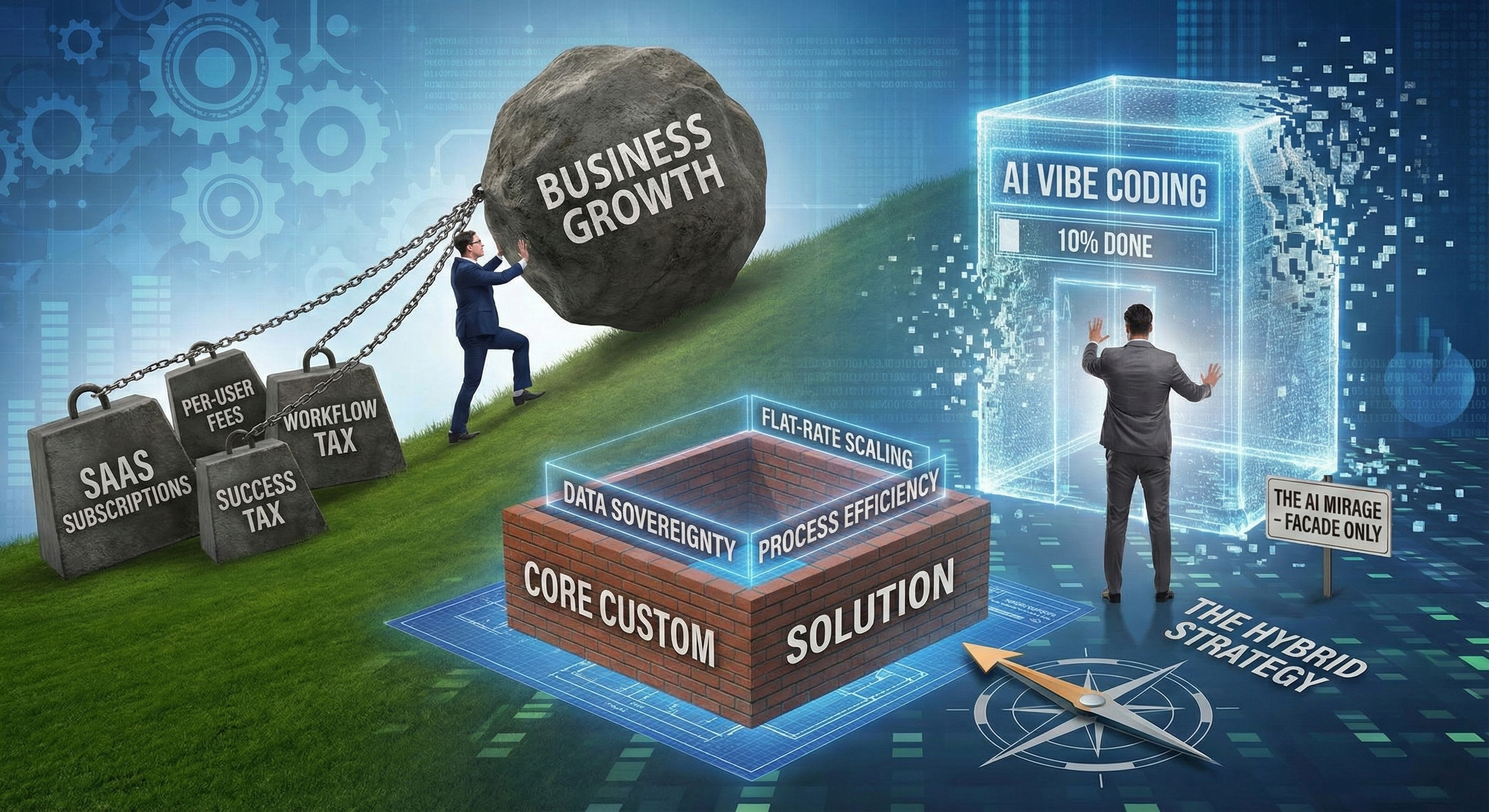
If you feel like your technology is fighting your growth rather than fueling it, you are likely caught between two dangerous extremes in the current market: The SaaS Trap and the AI Mirage.
Here is how to navigate the middle ground and build a technical foundation that actually scales.
1. The Hidden Cost of Renting: The "Success Tax"
We live in the golden age of SaaS (Software as a Service). You can sign up for a CRM, an ERP, and a Project Management tool in five minutes.
But SaaS business models are often misaligned with your business model. Most off-the-shelf software charges by the "seat" or per user. This creates a phenomenon I call the Success Tax.
The more successful you are and the more people you hire, the more you are penalized.
The Scenario: You hire 10 new sales staff.
The Reality: Your Salesforce bill jumps by $1,500/month.
The Friction: You start sharing logins to save money, compromising security and audit trails.
Beyond the cost, there is the Workflow Tax. Generic software is built for the average user. It handles 80% of what you need. The remaining 20%, specifically the way you handle inventory or your unique client onboarding process, has to be hacked together with manual data entry or third-party patch tools like Zapier.
When you rely entirely on rented software, you are paying a premium to run your business exactly like everyone else.
2. The False Promise of Speed: The "AI Mirage"
On the other end of the spectrum, frustrated leaders are turning to AI. We are seeing a rise in "Vibe Coding," which is the practice of using AI tools to generate entire applications over a weekend.
This sounds like a dream. Why pay a developer when I can prompt an app into existence?
I recently audited a project where a client claimed their AI-generated app was "90% done."
The reality? It was 10% done.
AI is incredible at building the Facade, such as the user interface, the buttons, and the layout.
AI is terrible at building the Foundation, such as security, authentication, database integrity, and payment logic.
Non-technical founders are confusing a prototype with a product.
The Risk: An AI might write code that works today but breaks the moment 2 users try to log in simultaneously.
The Debt: When that "vibe code" breaks, there is no engineer who understands how it was built. You haven't built an asset; you have built technical debt.
The Strategic Framework: Commodity vs. Core
So, if renting is too expensive and AI coding is too risky, what is the solution?
You need a Hybrid Strategy. You must ruthlessly distinguish between what is a Commodity and what is Core to your business.
Phase 1: Identify the Commodities (Buy These)
These are problems that have been solved a million times. Do not reinvent the wheel here.
Communication: Don't build your own Slack. Use Slack or Teams.
Payroll/HR: Don't build a payroll engine. Use Gusto or ADP.
Standard Accounting: Use QuickBooks or Xero.
For these functions, the "Success Tax" is worth it because the maintenance cost of building your own would be astronomical.
Phase 2: Identify the Core (Build This)
This is the 20% of your operations that generates your profit. This is your "Secret Sauce."
Do you have a unique logistics routing method?
Do you have a proprietary client assessment algorithm?
Do you have a complex commission structure that no standard CRM can handle?
This is what you must own.
When you build custom software for your Core, you unlock three specific advantages:
Data Sovereignty: You own the database. You aren't liable to a SaaS vendor changing their API or holding your data hostage. You can run analytics without limits.
Flat-Rate Scaling: You can double your headcount without your software costs doubling. You pay for the infrastructure (servers), not the seats.
Process Efficiency: The software bends to your team's workflow, eliminating the need for "admin glue" or staff hired just to move data between mismatched systems.
The Verdict: Stop Renting Your Advantage
We recently worked with a mid-sized company that had ignored this framework. They were running five different SaaS platforms to manage one core workflow. They were bleeding cash on subscriptions and drowning in manual data entry.
We consolidated that entire "Franken-stack" into one custom web application.
The result?
Financial: The system paid for itself in 15 months through saved subscription fees.
Operational: Data entry time was slashed by 70%.
Strategic: They now own an IP asset that adds valuation to their company.
AI has a place in this process; it helps professional developers build faster. But it doesn't replace the need for architecture. And SaaS has a place, as it handles the boring stuff.
But for the heart of your business? Stop renting. Stop guessing. Start building.