
People often ask me: "Is SEO still relevant now that everyone is asking ChatGPT and Google's AI instead of clicking through search results?"
It's a fair question. AI Overviews now sit at the top of Google results, assistants like ChatGPT and Perplexity answer questions directly, and click-through patterns are shifting. But the conclusion many people draw, that SEO is dead, is exactly backwards. SEO isn't dead. It has evolved, and the fundamentals matter more than ever. Our recent client results prove it.
The Results: 2x Relevant Traffic in Month One, +80% More in Month Two
After we rebuilt one of our clients' websites, here's what happened to their relevant website visits:
Month 1: relevant website visits doubled compared to the pre-rebuild baseline.
Month 2: traffic grew by a further 80% on top of that.
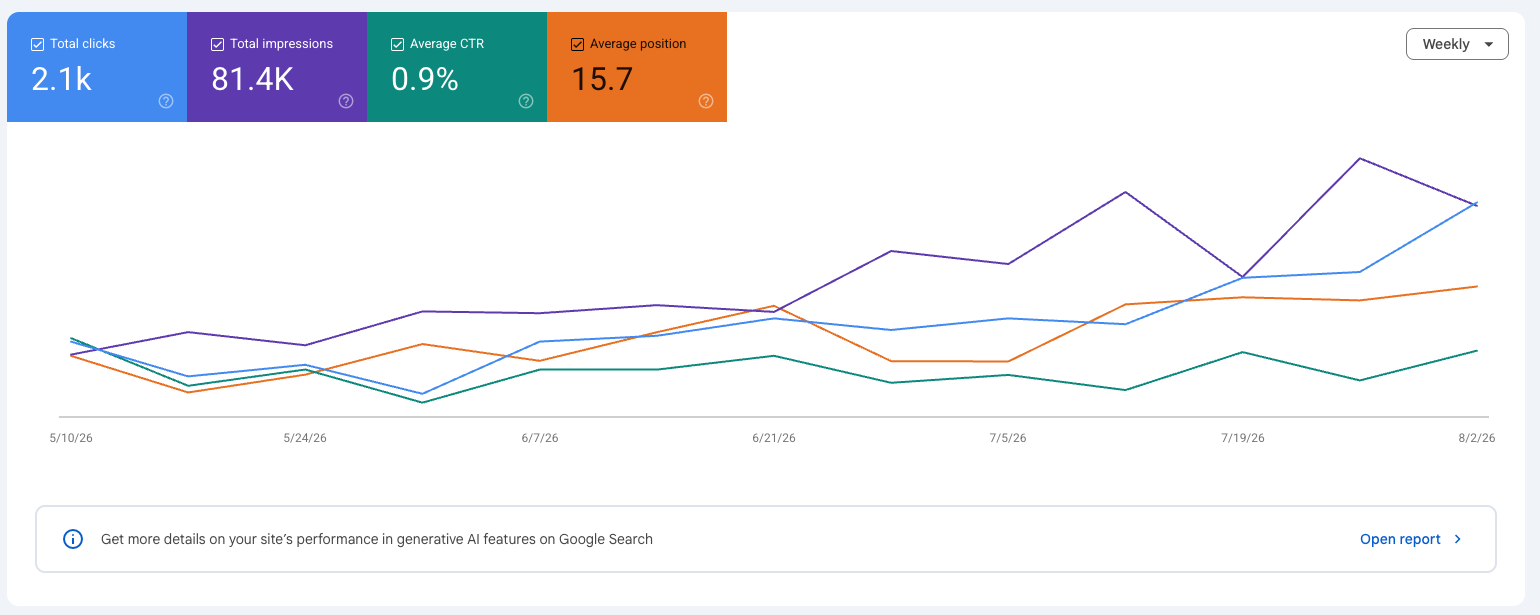
Here is the Google Search Console performance chart for the period, from the weeks before the rebuild through two months after:
A few things stand out in this data:
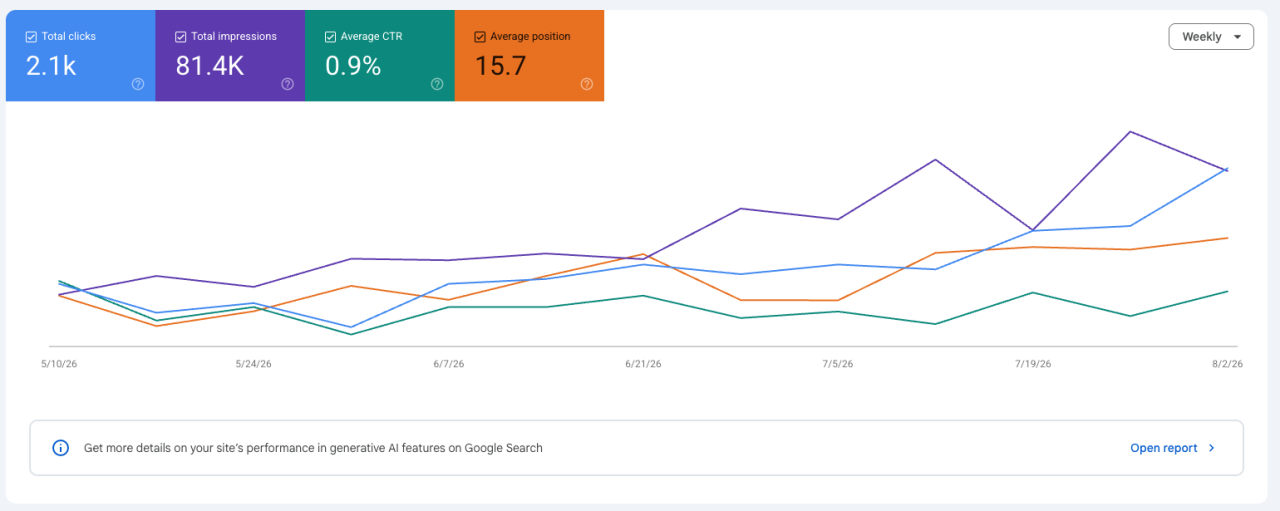
Impressions climbed steadily (purple line), reaching 81.4K over the period. Google is showing this website for far more searches than before, which means the rebuilt site is being crawled, understood, and deemed relevant for a wider set of queries.
Clicks followed (blue line), totaling 2.1K, with the trend accelerating rather than plateauing in the second month. This isn't a one-time spike from a relaunch; it's compounding growth.
Average position improved week over week (orange line trending up in the chart). As Google re-evaluated the faster, cleaner site, rankings moved up across the board, and every position gained multiplies both impressions and clicks.
Google itself flags the AI angle. Notice the banner at the bottom of the report: Search Console now offers details on the site's performance in generative AI features on Google Search. Google is explicitly measuring AI visibility, and this site is earning it.
It's also worth noting what this growth curve implies: rankings and impressions kept improving week after week, without new backlink campaigns or ad spend. The rebuild itself, the technical foundation, did the heavy lifting.
And here's the part that answers the "is SEO dead" question: a big chunk of that increase came from being featured in AI searches and AI Overviews. The same work that makes a website rank well in traditional search is what gets it cited by AI systems. The channels changed; the discipline didn't.
How AI Changed Where Your Customers Find You
When someone asks an AI assistant "who is the best [your service] near me?" or Google generates an AI Overview for a query in your niche, those systems don't invent answers out of thin air. They crawl, read, and analyze real websites, then synthesize what they find into an answer, often with citations and links to the sources.
This has given rise to a discipline alongside SEO that people are calling GEO (Generative Engine Optimization): optimizing your website so that AI systems can read it, understand it, trust it, and present it to your potential customers correctly. The good news? GEO isn't some mysterious new art. It rewards the same things good SEO always has: fast, clean, well-structured, machine-readable websites with genuinely useful content.
Why Page Speed Matters Even More Now
Website speed has been a Google ranking factor for years, and Core Web Vitals made it explicit. But in the AI era, speed and technical quality carry even more weight, because your website now has a whole new class of readers: machines.
AI crawlers are impatient. Bots from OpenAI, Anthropic, Perplexity, and Google fetch enormous numbers of pages. Slow responses and bloated pages mean fewer of your pages get crawled, analyzed, and included in AI answers.
Many AI systems read raw HTML. If your key content only appears after heavy JavaScript execution, some AI crawlers simply never see it. Clean, semantic, server-rendered HTML ensures machines get the full picture.
Agentic browsing is here. AI agents now visit websites on behalf of users to compare options, fill out forms, and complete tasks. Google's PageSpeed Insights has even added an "Agentic Browsing" readiness check. If an agent can't navigate your site, it will move on to a competitor's.
Humans still hate slow sites. None of this replaces the classic reason speed matters: every extra second of load time costs you conversions, especially on mobile.
In short: it used to be that you optimized your website so Google could read it and humans would enjoy it. Now you're optimizing for humans, search engines, and AI models, and the AI models are the pickiest readers of all.
Before and After: Real PageSpeed Results
Talk is cheap, so here are real Google PageSpeed Insights reports (mobile, which is the harder test) showing what a typical client website looks like before they come to us, and what it looks like after we rebuild it.
Before the Rebuild
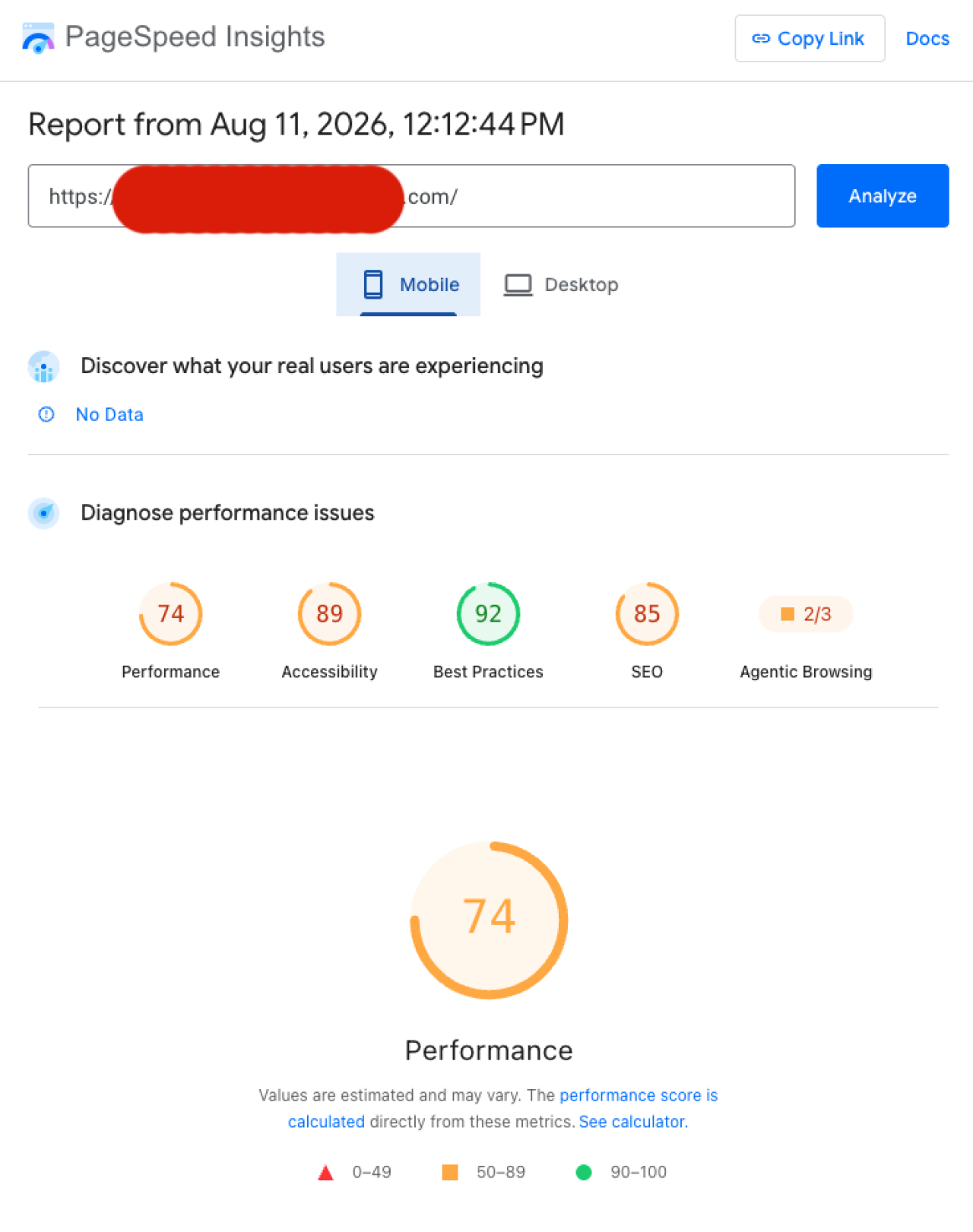
Performance: 74
Accessibility: 89
Best Practices: 92
SEO: 85
Agentic Browsing: 2/3
These numbers aren't terrible. This is what a "decent" website looks like. And that's precisely the trap: a site that looks fine to the business owner is quietly losing visibility with every crawl.
After the Rebuild
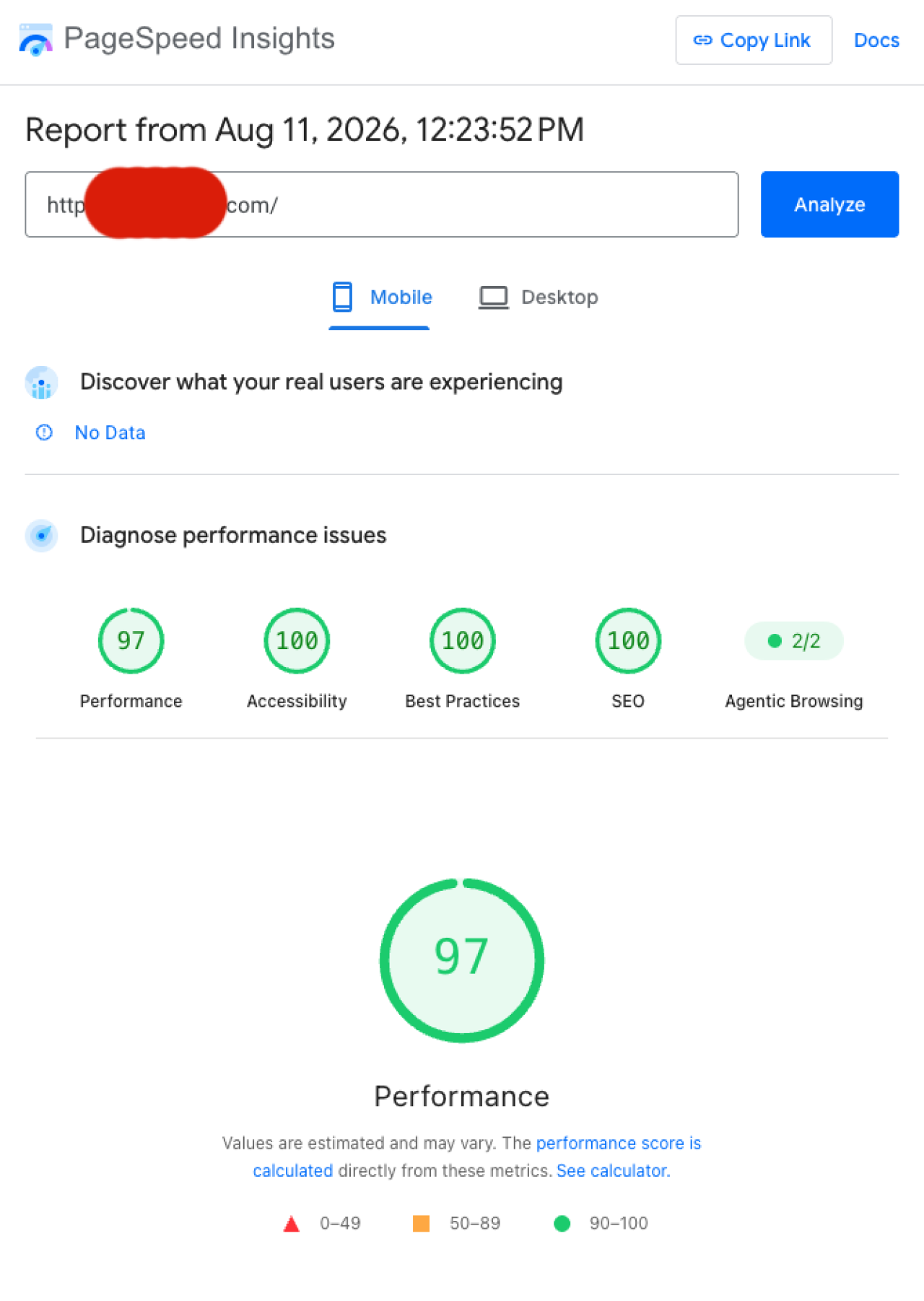
Performance: 97
Accessibility: 100
Best Practices: 100
SEO: 100
Agentic Browsing: 2/2
Every metric in the green, a perfect SEO score, full agentic browsing readiness, and a mobile performance score of 97. This is the technical foundation that both Google and AI systems reward, and it's what powered the traffic growth described above.
What Goes Into an AI-Ready Website Rebuild
Scores like these aren't achieved by installing a caching plugin and hoping for the best. When we rebuild a website, we focus on:
Clean, semantic HTML. Proper heading hierarchy, meaningful markup, and content that is present in the HTML itself, not hidden behind JavaScript that machines may never execute.
Structured data (Schema.org). Explicitly telling machines who you are, what you offer, where you operate, and how to reach you, so search engines and AI models don't have to guess.
Core Web Vitals optimization. Optimized images, minimal render-blocking resources, lean CSS and JavaScript, and fast server response times.
Accessibility. An accessible website is easier for humans with assistive technologies to use, and easier for machines to parse. It's no coincidence that accessibility and AI readability improve together.
Content architecture. Clear page-per-topic structure, descriptive URLs, internal linking, and content written to directly answer the questions your customers actually ask, which is exactly the format AI answers are built from.
Frequently Asked Questions
Is SEO still worth it in 2026?
Yes, arguably more than ever. AI answers are built from crawled web content, so websites that are technically sound and content-rich get cited in AI Overviews and assistant responses. Businesses that abandon SEO now are also abandoning AI visibility.
What is GEO (Generative Engine Optimization)?
GEO is the practice of optimizing your website so generative AI systems (Google AI Overviews, ChatGPT, Perplexity, and others) can accurately read, understand, and cite your content. It builds on traditional SEO fundamentals: speed, structure, semantic markup, and quality content.
Does page speed really affect AI search visibility?
Yes. AI crawlers operate under time and resource budgets. Slow, heavy, JavaScript-dependent pages are crawled less thoroughly, and sometimes not at all, which means your content never makes it into the AI's answer. Fast, lightweight pages get read fully and represented accurately.
SEO Isn't Dead. It Just Has a New Audience.
The websites winning in the age of AI aren't doing anything magical. They load fast, they're built cleanly, they're accessible, and their content is structured so that both a human on a phone and a machine building an answer can understand them instantly. That's SEO. That's GEO. And as our client's numbers show, doubling traffic in a month and growing another 80% the next, it works.
Wondering what your website's scores look like, and what they're costing you in AI-era visibility? Get in touch and we'll take a look.